
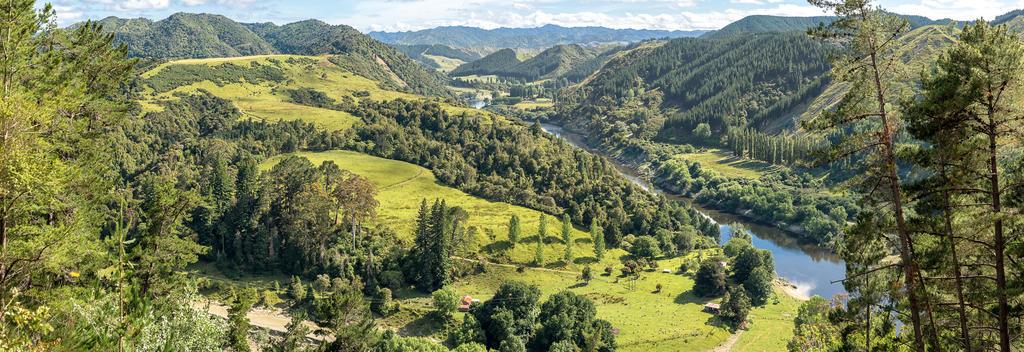


This national park is home to the mystical Whanganui River, New Zealand's longest navigable waterway.
Located in the central North Island, the park was created to protect the upper reaches of the Whanganui River. Once an important transport route for both Maori and early European settlers, the 290km-long river flows from Tongariro National Park to the Tasman sea through wild lowland forests. The land surrounding the Whanganui River is remote and rugged and full of the melodies of abundant native birdlife.

The Whanganui National Park has a very distinctive landscape of river valley systems with steep slopes, razor-sharp ridges and an almost complete cover of native lowland forest. The park is at the centre of a large sedimentary basin, so the rocks are mostly mudstones - easily sculpted by the river into fascinating shapes.
For bird watchers, there is much to be seen. There are large numbers of kereru (native pigeon), piwakawaka (fantail), tui, toutouwai (robin), riroriro (grey warbler) and miromiro (tomtit). The beautiful whio (blue duck) is the target of a Department of Conservation recovery plan, and numbers are increasing steadily.
You can also hope for sightings of kākā and yellow-crowned parakeets. At night it's even possible to hear the call of the North Island brown kiwi.


Although it's water-based, the Whanganui Journey is classed as one of New Zealand's 'Great Walks'. The 145 kilometre river trip runs from Taumarunui to the village of Pipiriki, taking about five days to complete by canoe or kayak. A three-day journey from Whakahoro to Pipiriki is also possible. There are a few easy-to-access huts and campsites dotted along the riverbanks. An overnight stay at Tīeke Marae is a special highlight. Run by local Maori, the marae is a chance to see local customs in action.
Jet boats operate from both ends of the Whanganui River, providing visitors with rewarding day trips into the heart of the park. From Pipiriki you can journey up the river to the Bridge To Nowhere, which is all that remains of Mangapurua, an isolated settlement that was abandoned in 1942.
The Matemateaonga Track is one of the most popular long walks in the park. It follows an old Māori trail and takes about four days to complete. The Mangapurua Track(opens in new window), which takes 3 - 4 days, starts at Whakahoro and ends at the 'Bridge to Nowhere'. Most people walk into the Bridge and take a jet boat out. Further south is the Ātene Skyline Track(opens in new window), an excellent one day walk accessible from Whanganui River Road.
The Department of Conservation(opens in new window) provides three Great Walk hikers' huts and a large number of campsites along the path of the Whanganui Journey. Bookings are required during the peak season from 01 October - 30 April for the huts on the Whanganui Journey Great Walk. There are 'Serviced' category huts along the Matemateaonga Track. View fees(opens in new window) for DOC accommodation.
Various types of overnight accommodation can be found in Taumarunui, which is close to the northern boundary of the park. The city of Whanganui provides a wide choice of accommodation at the southern end. There are a few bed and breakfast establishments between Whanganui and Pipiriki.


