Toi - Māori Arts

Māori creative arts like weaving, carving and tattooing celebrate the past and continue to evolve through fresh inspiration and new materials.

Add to
Trip Planner

Raranga – the art of weaving

Camera The long fibres of harakeke leaves are woven to create textiles with flexibility and strength.

The long fibres of harakeke leaves are woven to create textiles with flexibility and strength.

Camera The long fibres of harakeke leaves are woven to create textiles with flexibility and strength.

The long fibres of harakeke leaves are woven to create textiles with flexibility and strength.

When Māori first arrived in Aotearoa, they encountered a climate that was extreme compared to their homelands in Polynesia. They adapted quickly by utilising their existing twining and weaving skills to produce korowai (cloaks) and other practical objects such as kete (baskets) and whāriki (mats). The most widely used weaving material was (and still is) harakeke - otherwise known as New Zealand flax.

Weaving women

Weaving is traditionally done by women and skilled weavers are prized within their tribes. 'Aitia te wahine o te pā harakeke' is a Māori proverb that translates to mean 'Marry the woman who is always at the flax bush, for she is an expert flax worker and an industrious person'.

Cloaks of beauty

Camera Maori feather cloak

Maori feather cloak

Camera Maori feather cloak

Maori feather cloak

Traditionally, cloaks were woven by hand between two upright weaving pegs. Feathers and decorative threads were integrated into the fabric as the weaving progressed. Natural dyes were used to achieve a variety of colours; paru (swamp mud) was used to achieve a black tone and tanekaha (bark) produced brown.

The kahu kuri was the most prized of cloaks, incorporating strips of dog skin. The kuri (native Polynesian dog) came to New Zealand with the first Māori. Kahu kuri were only worn by rangatira (chiefs).

Whakairo – the art of carving

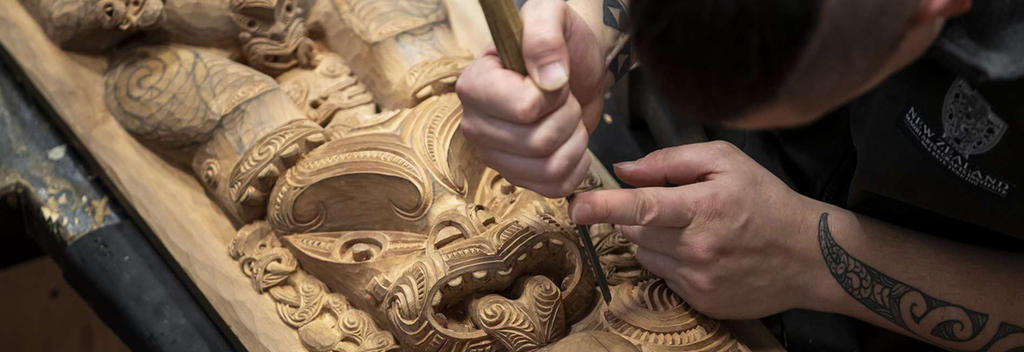
Camera The knowledge, protocols and skills of Maori carving have been passed down through the generations.

The knowledge, protocols and skills of Maori carving have been passed down through the generations.

Camera The knowledge, protocols and skills of Maori carving have been passed down through the generations.

The knowledge, protocols and skills of Maori carving have been passed down through the generations.

Rather than purely being decorative, whakairo (Māori carvings) each give a unique narrative. The stories passed down through generations explain cultural traditions and tribal history. Traditionally Māori carvers were men; their craft included precious adornments, weapons, tools, musical instruments and decorative panels and posts for the various buildings within the village.

A sign of prestige

Precious adornments were (and are still) worn as a sign of prestige; they included ear pendants, breast pendants and carved combs worn in the hair. These were made from pounamu (jade or greenstone), whale ivory and whale bone, although other materials, like albatross feathers and sharks teeth, were also incorporated. Pounamu from the South Island is highly prized for its beauty and strength, and is still used for making adornments today.

Symbols and patterns

Maori carvings are rich in symbolism and use common patterns, though styles differ between tribes. Symbols include the tiki, which represents the human figure, and the manaia, a creature with bird-like head and serpent-like body, associated with guardianship. Traditional patterns used in carving were often inspired by the natural environment, including spider webs (pungawerewere), fish scales (unaunahi) and the unfurling fronds of the fern (koru).

Tā moko – the art of tattoo

Camera Some ta moko artists, like Henriata Nicholas of Rotorua, work with traditional hand-made chisels.

Some ta moko artists, like Henriata Nicholas of Rotorua, work with traditional hand-made chisels.

Camera Some ta moko artists, like Henriata Nicholas of Rotorua, work with traditional hand-made chisels.

Some ta moko artists, like Henriata Nicholas of Rotorua, work with traditional hand-made chisels.

Tā moko is more than a tattoo – it’s a Māori sign of identity. It reflects the individual’s whakapapa (ancestry) and personal history. In earlier times it was an important signifier of social rank, knowledge, and even eligibility to marry.

For men and women

Traditionally men received moko on their faces, buttocks and thighs. Women usually wore moko on their lips and chins. Moko was sometimes applied to other parts of the body, including the forehead, neck, back, stomach and calves.

Today, moko is experiencing resurgence, both in traditional and modern forms. Where Māori designs are used for aesthetic reasons, without the traditional significance, this is referred to as kirituhi or skin art.

From hammer and chisel to modern tools

Before the arrival of European settlers, the complex designs of tā moko were literally carved into the skin. A rake-like instrument, usually made of teeth or bone, was used to break the skin; then a flat edged blade was used to tap in the dye, creating a tattoo with a scarred, chiselled appearance. The pigment used was soot obtained from burning kahikatea, or white pine, sometimes mixed with kauri gum or soot from the oily koromiko (hebe) shrub.

Camera Your heritage recorded for all to see

Your heritage recorded for all to see

Camera Your heritage recorded for all to see

Your heritage recorded for all to see

The modern tool of tā moko is the tattoo machine, although some tā moko artists alternate between traditional and modern methods. While the needle is faster and more precise, hand tools bring the ritual more in line with how it was done traditionally.

Take a look for yourself

Cultural centres and workshops

You can get a closer look at Māori art forms at cultural centres and studios throughout New Zealand. One such place is Te Puia in Rotorua, which allows visitors into its weaving and carving schools to watch the artists at work. If you’d like to have a go, look out for workshops offering lessons in basic weaving and carving techniques.

Galleries and museums

Many art galleries throughout the country sell work by prominent Māori artists, and both traditional and modern Māori art is sought by collectors worldwide. For a look at historic Maori art pieces, visit museums like Te Papa and the Auckland Museum.

Māori cultural experiences

Tā moko is a more elusive art form to observe, given that it exists on the living canvas of the human body. However, you’ll no doubt see examples of Māori moko if you book in a Māori culture show or marae visit. In these settings, your Māori hosts can explain to you what their tattoos represent. 

However you choose to experience the Māori arts, you're sure to be intrigued and inspired. You may even find a special taonga (treasure) to take home.